
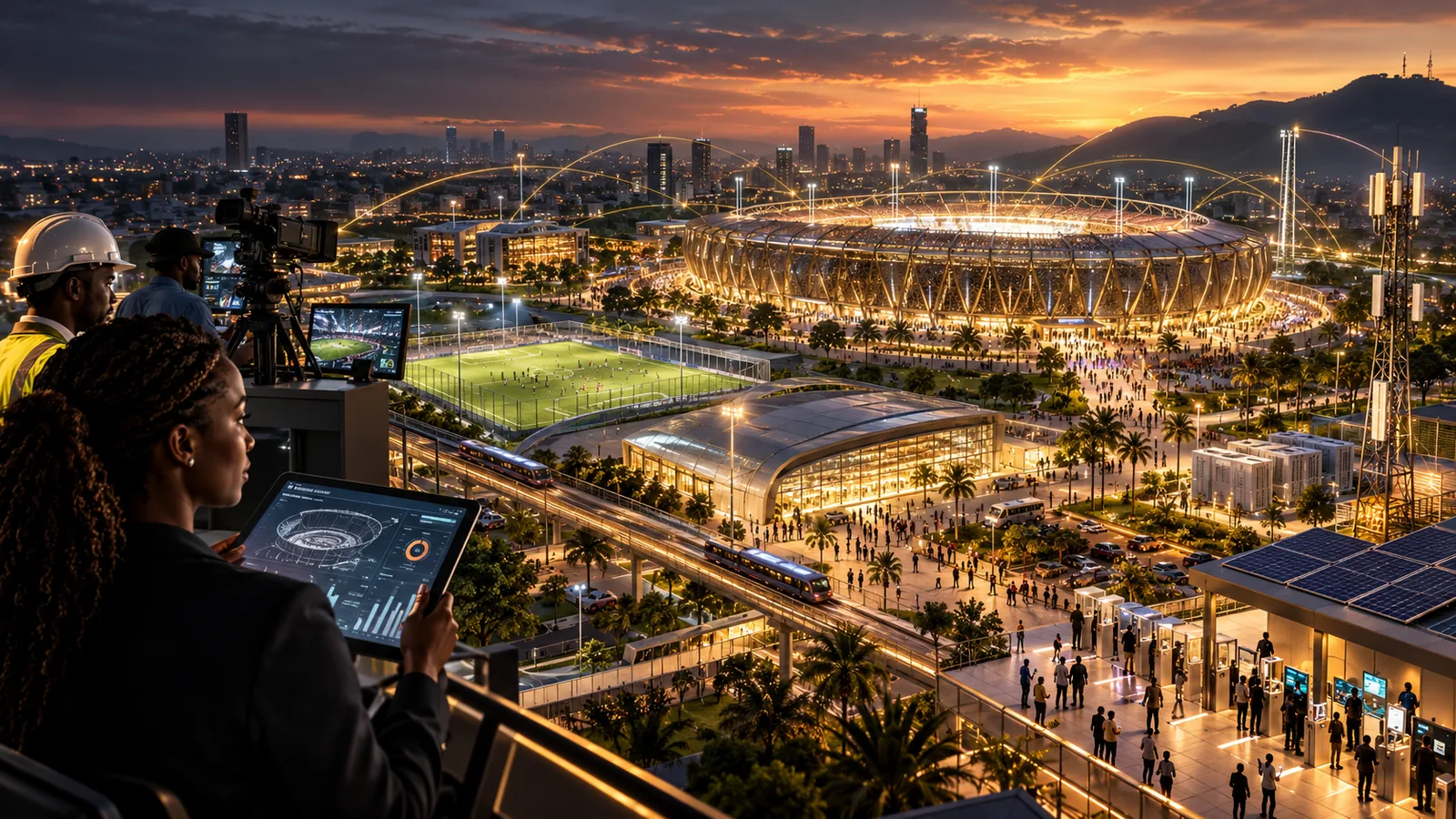
The infrastructure debate is too focused on construction
Sports infrastructure in Africa is often discussed through capacity.
How many seats?
How many stadiums?
How many arenas?
How much construction finance?
These questions matter.
But they do not determine whether an asset will work commercially.
A modern sports facility is valuable when it can be used frequently, operated efficiently, connected digitally, monetised commercially and integrated into the surrounding economy.
Technology changes that equation.
It allows a stadium to become a production site.
A retail environment.
A data platform.
A transport node.
A community asset.
A year-round entertainment destination.
And it allows a training ground to become an athlete-development system.
Connectivity should be core infrastructure
The most important technology investment in a venue may not be the giant screen.
It is connectivity.
Reliable fibre, mobile coverage, Wi-Fi, resilient power and production-grade network architecture determine whether ticketing, payments, security, broadcasting and digital fan services work properly.
Africa's broader connectivity infrastructure continues to expand.
GSMA expects African mobile operators to invest more than $76 billion in networks between 2024 and 2030.
The World Bank has also highlighted the importance of innovation in the development and financing of Africa’s digital infrastructure, including private-sector ownership and investment models that expanded connectivity and reduced bandwidth costs.
Sports facilities should be designed to benefit from this infrastructure rather than becoming isolated buildings.
Broadcast-ready venues create recurring value
Production capability is equally important.
Many facilities are built without enough attention to camera positions, connectivity, commentary locations, power redundancy, control spaces and data capture.
The result is that every broadcast becomes a temporary infrastructure project.
A broadcast-ready stadium lowers the cost of producing every event held inside it.
That benefits professional sport.
But it can also make school, university, women's and community competitions more economically producible.
Cloud and remote production make this even more important.
The venue of the future may require fewer production staff on site.
But it will require better connectivity and more standardised technical infrastructure.
Broadcast readiness should therefore be considered revenue-enabling infrastructure.
Digital ticketing is more than an entry system
Access technology is another major opportunity.
Digital tickets and integrated membership systems can improve crowd flow and reduce fraud.
But their real value is identity.
A venue that knows who attended can communicate before and after the event.
It can understand attendance frequency.
It can segment supporters.
It can sell hospitality.
It can build loyalty.
And it can provide sponsors with significantly better audience intelligence.
The ticket becomes the beginning of a customer relationship rather than a one-time permission to enter.
Smart does not have to mean expensive
Africa should be careful not to import technology-heavy stadium models that require unrealistic operating budgets.
The most commercially valuable technologies can often be modular.
Solar and batteries for energy resilience.
Digital access control.
Automated cameras.
Software-based venue management.
Mobile-money payments.
Low-cost sensors.
Modular LED.
Cloud production.
Maintenance analytics.
A retrofit of an existing municipal stadium with connectivity, access systems and production capability may produce a better economic return than a new prestige stadium that remains empty for most of the year.
The test should be operating value per unit of capital.
Training facilities can become intelligent
The technology opportunity also extends beyond spectator venues.
Academies and training centres can use video, athlete-management platforms, GPS, computer vision and testing data to monitor player development.
FIFA’s talent-development strategy increasingly emphasises technology and structured information as tools for identifying and developing athletes.
For Africa, this has particular value.
Athletes are geographically dispersed.
Resources are unevenly distributed.
A training pitch with automated video and reliable data collection can become part of a much larger scouting and development network.
Stadiums can anchor urban districts
The strongest infrastructure projects also connect sport to transport, retail, hospitality, health, education and entertainment.
Technology makes those relationships measurable.
Mobility information can improve transport.
Ticketing and spending patterns can inform tenant mix.
Events can support tourism.
Public Wi-Fi can serve surrounding communities.
Digital signage can create advertising inventory.
Renewable power can support adjacent developments.
This is how a stadium moves from being an occasionally occupied structure into an operating urban platform.
Better information can unlock better finance
Investors want to understand utilisation, operating costs, tenants, maintenance, revenues and future demand.
Digital infrastructure makes those economics more visible.
That makes facilities easier to benchmark.
Easier to operate.
And potentially easier to finance.
The long-term opportunity in African sports infrastructure is therefore not simply building more venues.
It is building venues capable of explaining their own economics.
SIA perspective: The most important sports infrastructure of the next decade will combine concrete with connectivity. Africa has an opportunity to leapfrog legacy venue models by building around production, data, flexible use and digital commerce from the outset.
Published by the Sports Intelligence Africa editorial team.