
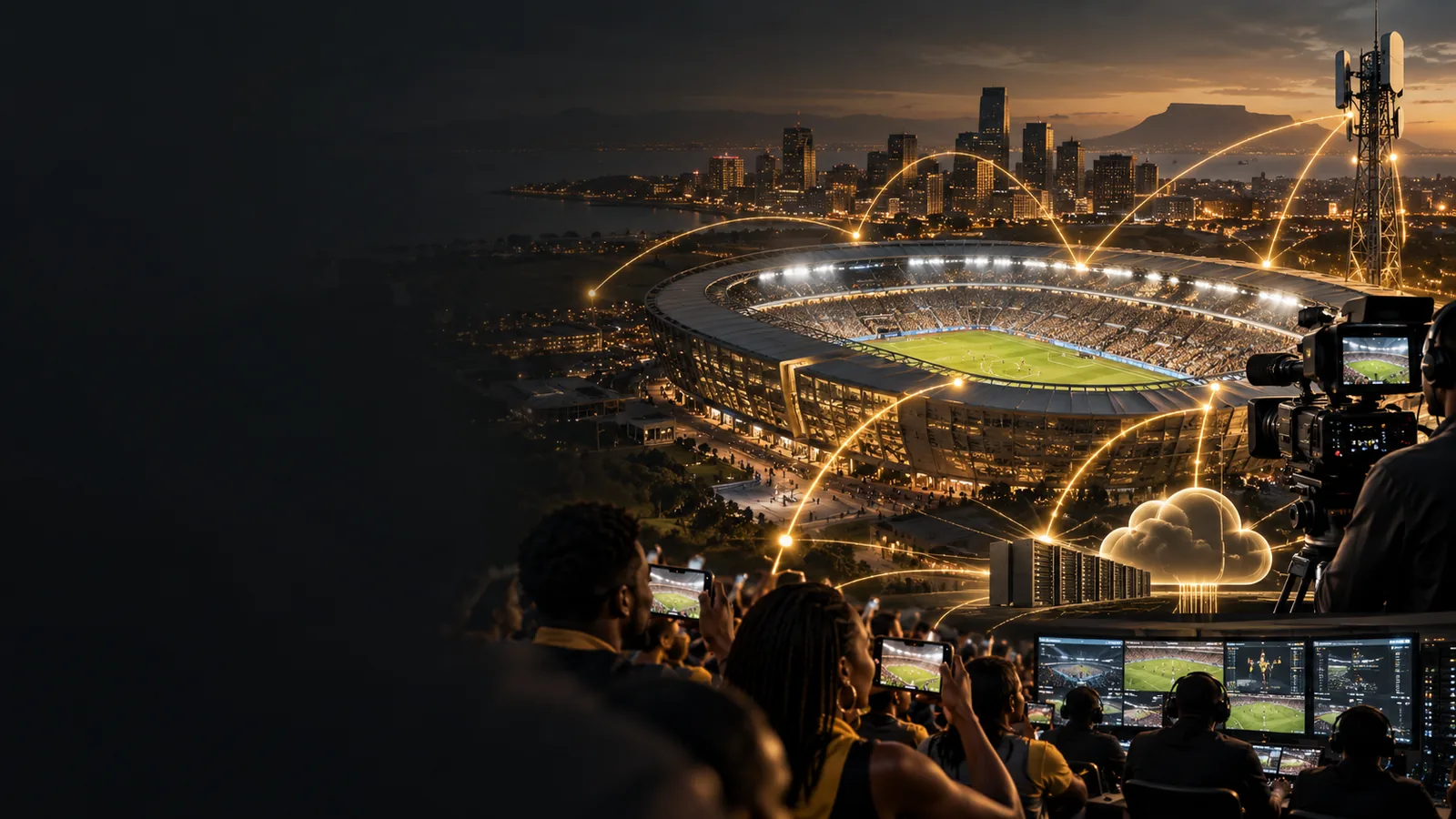
A stadium can be structurally complete and still be digitally unready.
Modern sport places a different load on venues from even a decade ago. Thousands of fans want simultaneous mobile connectivity. Broadcasters move high-resolution video. Teams use cloud analysis. Payments need to clear instantly. Security systems stream data. Sponsors run digital activations. Journalists upload content in real time.
Connectivity is now part of the sporting product.
The venue is an edge network
The most effective way to think about a modern stadium is as a temporary high-density city and a permanent edge-computing environment.
It requires fibre, resilient backhaul, public and private wireless networks, redundancy, cybersecurity and power. Large events can generate traffic spikes far beyond ordinary neighbourhood demand.
During AFCON in Côte d'Ivoire, Orange and its technology partners deployed distributed antenna systems to improve stadium coverage and capacity. At DP World Wanderers Stadium in Johannesburg, 5G connectivity forms part of a broader smart-venue model.
These are not premium extras. They are increasingly prerequisites for modern event operation.
Broadcast has moved onto the network
As production becomes more IP-based, the boundary between telecom infrastructure and broadcast infrastructure is disappearing.
Remote production depends on reliable contribution feeds. Cloud editing depends on upload. Digital clipping depends on low latency. Commentary and graphics teams may operate far from the venue.
For African leagues trying to reduce production costs, venue connectivity can therefore determine whether a centralised production model is possible.
CDNs bring the event closer to the fan
The network challenge does not end at the stadium. High-demand sports streams need to be delivered efficiently across national mobile networks.
After AFCON 2025, Orange said its Content Delivery Boost infrastructure enabled 92% of relevant video traffic to be processed locally across 12 Orange markets. Local caching reduced pressure on central servers and improved responsiveness for Max it users.
This demonstrates the importance of distribution architecture to the fan experience. A rights-holder can own excellent content and still deliver a poor product if the network path is inefficient.
Telcos are moving deeper into the value chain
Telecommunications companies can now participate in African sport at multiple levels: venue connectivity, sponsor rights, mobile distribution, billing, data bundles, fan applications and cloud infrastructure.
This creates opportunities for partnership structures that go beyond a conventional sponsorship fee. A telco may contribute network capex or in-kind infrastructure in exchange for customer acquisition, data products, content rights or commercial exclusivity.
The challenge is to value each contribution clearly so the sports property understands the full economics of the deal.
Infrastructure needs open architecture
Venue technology often arrives in layers over many years. Without interoperability, the operator can end up with separate systems for ticketing, CCTV, Wi-Fi, signage, point of sale and broadcast that cannot share data.
Procurement should therefore consider APIs, data ownership, security, portability and lifecycle cost — not simply the cheapest installation.
SIA takeaway
Connectivity has become part of African sports infrastructure in the same way as seating, lighting and the pitch. The venue of the future is a networked production and fan environment. Telcos, broadcasters and technology partners that design that infrastructure together can lower media costs, improve fan experience and create new commercial inventory at the same time.
Editorial source notes
- Orange Wholesale, AFCON 2025 CDN case study, March 2026.
- Orange / ANDREW AFCON Côte d'Ivoire stadium connectivity case study.
- Acronis case study, DP World Wanderers Stadium, 2025.
- CAF Broadcast Academy, 2025.
Published by the Sports Intelligence Africa editorial team.