
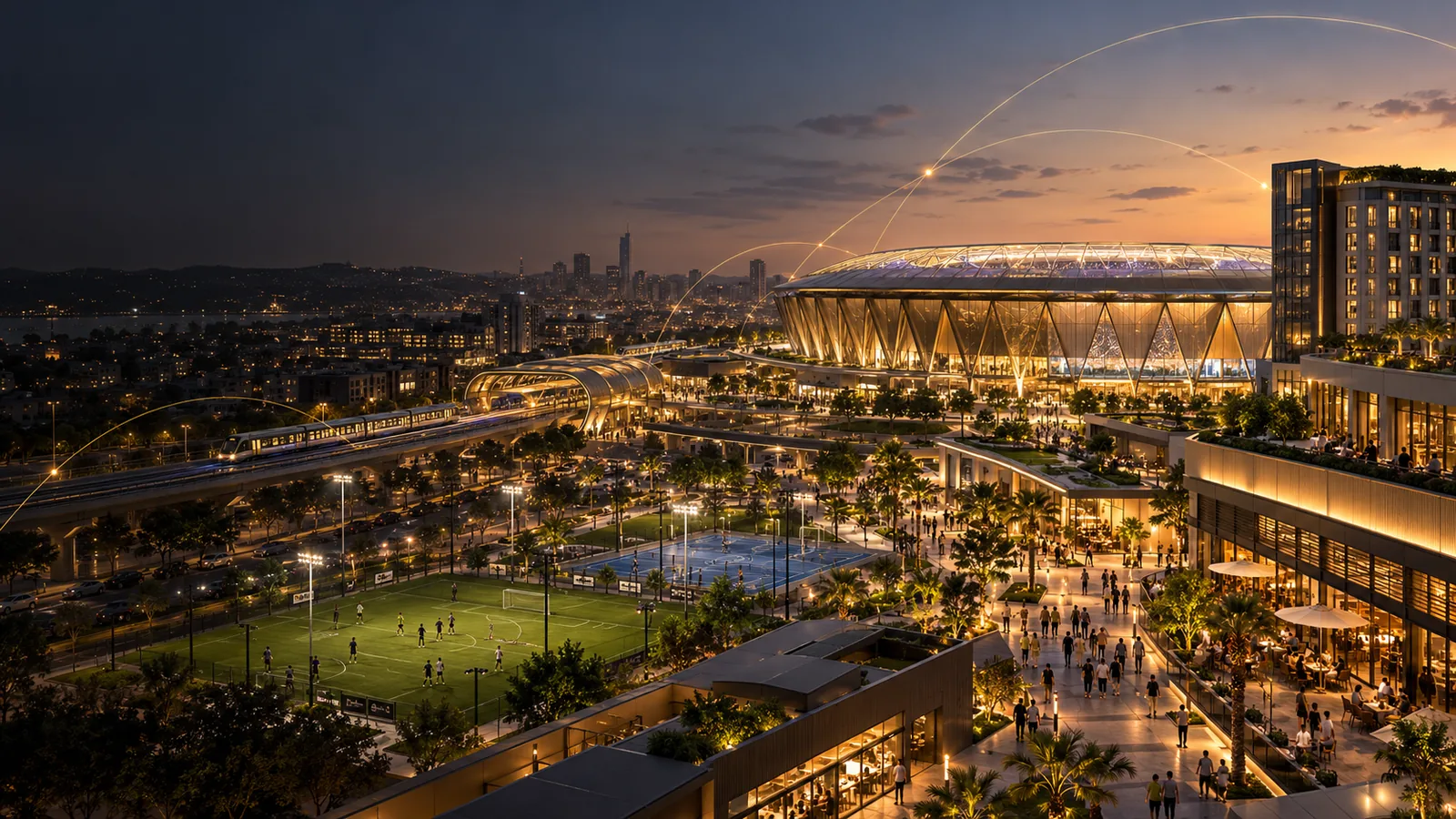
African sports infrastructure is entering a new investment cycle.
Continental tournaments, urbanisation, sports tourism and the growth of professional leagues are driving demand for stadiums, arenas, training centres and community facilities. But the central investment question is changing.
The issue is no longer simply whether Africa needs more sports infrastructure. It is what kind of infrastructure can remain economically productive after the opening ceremony.
Public investment remains essential
Large national stadiums and tournament infrastructure often require public capital because their strategic value extends beyond direct operating profit. They support national events, tourism, civic identity and sports development.
The challenge is lifecycle economics. Construction budgets attract political attention; maintenance, technology renewal and operating capability receive less.
A sustainable model therefore needs to plan the operating business before the asset is built.
PPPs can allocate risk more intelligently
Public-private partnerships and concessions can bring private operating discipline into publicly strategic assets. The private party may finance, operate or commercialise parts of the venue in exchange for a long-term concession or revenue share.
The effectiveness of the structure depends on risk allocation. Demand risk, construction risk, maintenance, security, utilities and event acquisition need to sit with the party best able to manage them.
Poorly structured PPPs simply disguise public liabilities. Well-structured ones create incentives for utilisation and maintenance.
Mixed-use changes the venue equation
Zaria Court Kigali is one of the clearest African examples of a different model. The development combines sports and events with hospitality and lifestyle real estate, supported by institutional and bank capital.
The investment case is strengthened because revenue does not depend only on match days. Hotel rooms, food and beverage, events and other uses create additional cash flows and reasons for people to visit the site.
For African cities, this model may be more relevant than replicating large single-purpose stadiums.
Technology is a capital layer
Venue investment increasingly includes digital systems: connectivity, access control, ticketing, screens, production facilities, cybersecurity, payments and data platforms.
These systems require renewal cycles much shorter than concrete structures. Investors and operators therefore need to separate building capex from technology capex and create budgets for continuous upgrades.
The stadium should not be considered complete when the physical construction is finished.
Development finance can support ecosystem outcomes
Sports infrastructure can intersect with job creation, tourism, youth development, urban regeneration and the creative economy — areas that can attract DFI and impact-oriented capital when projects are commercially credible.
The IFC and Proparco investment into Helios Sports and Entertainment explicitly includes infrastructure development alongside IP, events, retail and hospitality, demonstrating how these categories increasingly sit inside one investment thesis.
The bankability test
An investable sports-infrastructure project needs credible answers to five questions:
- Who will use the asset, and how often?
- What are the recurring revenue streams beyond ticket sales?
- Who owns and operates the facility over its full lifecycle?
- How will technology and maintenance be funded?
- What public value justifies any government participation?
If those questions are answered only after construction, the project is already at risk.
SIA takeaway
Africa's next generation of sports infrastructure should be designed as productive urban infrastructure, not monuments. The strongest projects will combine sport with hospitality, commerce, connectivity, events and community use, while matching each source of capital to the risk and return it is best suited to carry.
Editorial source notes
- IFC / Proparco investment in Helios Sports and Entertainment, July 2025.
- Zaria Court Kigali project and financing disclosures, 2025–2026.
- FIFA Forward infrastructure investments in African football associations, 2025.
- CAF / host-country stadium modernisation programmes for AFCON 2025.
Published by the Sports Intelligence Africa editorial team.